
Tire Market Insights and Analysis

Expert analysis of mobility and the global tire industry

Tire Industry Trends
This will hold the preview of the blog post

New analysis from Astutus Research reveals that total annual Vehicle Kilometres Travelled (VKMT) by European light vehicles will exceed pre-pandemic levels for the first time in 2025, with VKMT projected to surpass 2019 figures by 1.3%. Central Europe is identified as the key driver of this recovery, showing robust growth compared to a more subdued performance in Western Europe.

The findings, published in the VKMT in Europe 2025 Q1 report, highlight significant disparities in vehicle travel recovery patterns across the continent.

Central Europe is forecast to see total VKMT rise 8.5% above 2019 levels by the end of 2025, positioning the region as a focal point for automotive sector growth and investment.
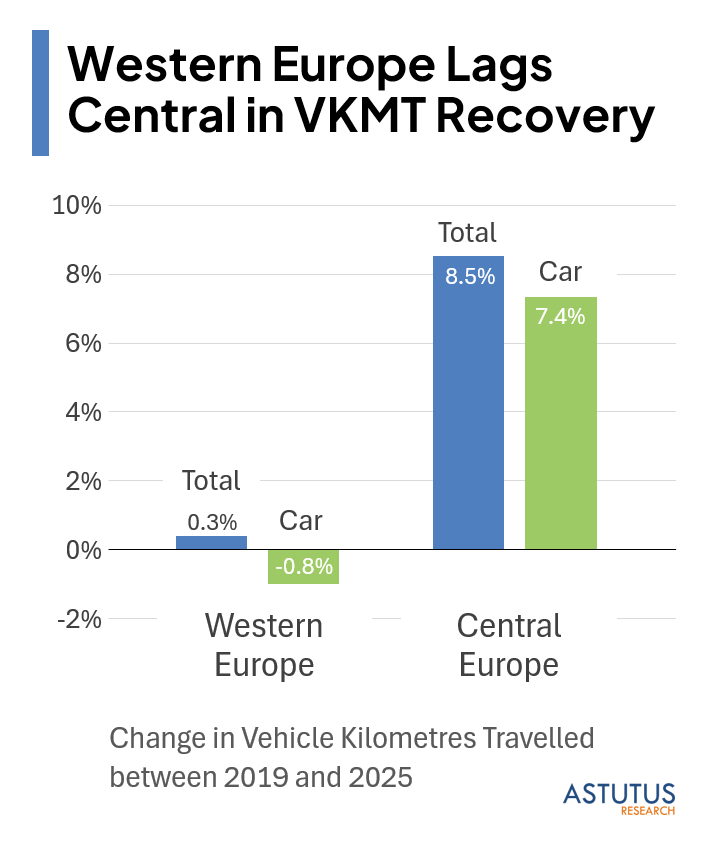
In contrast, Western Europe continues to face challenges, particularly with passenger car VKMT still 0.8%below pre-pandemic levels. A complete recovery in this segment is now not expected until 2026.

“This divergence is more than just a post-COVID hangover,” said Simon Hodson, Research Director at Astutus Research. “Central Europe’s freight-led recovery reflects the area’s strengths in manufacturing and logistics. Meanwhile, changing commuting habits continue to weigh on car mileage in Western Europe. For OEMs and suppliers, these shifting patterns offer clear signals about where opportunities lie.”

Report Availability

The VKMT in Europe 2025 Q1 report includes an interactive Power BI dashboard, a downloadable Excel dataset, and a PDF analysis covering VKMT growth, regional differences, updated economic forecasts, and emerging trends in rail transport.

About Astutus Research

Astutus Research is a specialist provider of data, insight and forecasts for the tire industry and the broader aftersales segment. We cover the complete tire lifecycle: from production and distribution to usage, disposal and recycling. Our mission is to help clients make smarter decisions with exclusive research covering customers, competitors, and market dynamics.

Tire Industry Trends
This will hold the preview of the blog post

European tyre markets began 2025 with mixed results as consumer demand continued its recovery trajectory whilst commercial segments faced further challenges. Q1 data shows consumer tyres declining just 3% compared to the strong Q1 2024, with All Seasons tyres driving growth at 14%. However, truck and bus segments dropped 4%, highlighting ongoing economic uncertainties.

Download the full ETRMA Q1 2025 report below for comprehensive market analysis, import data, and passenger mobility trends.

Tire Industry Trends
This will hold the preview of the blog post

European tyre markets closed 2024 on a positive note, with Q4 replacement volumes rising across all segments. Consumer tyres led the recovery with 12% quarterly growth, whilst truck and bus segments showed encouraging signs with 4% increases. Despite this progress, full-year performance remains mixed, with consumer sales up 5% but commercial segments still declining.

Read the complete ETRMA Q4 report below for detailed market analysis, sustainability insights, and mobility trends shaping the industry.

Tire Industry Trends
This will hold the preview of the blog post

ETRMA's latest quarterly data reveals a mixed picture for Europe's tyre industry, as consumer tyre sales gain momentum with a 5% quarterly boost whilst truck and bus segments continue to struggle with declining volumes.

Get the complete quarterly report here (free download) for in-depth insights into vehicle parc evolution and electric vehicle trends across Europe.

Tire Industry Trends
This will hold the preview of the blog post

In this update from the European Tyre & Rubber Manufacturers Association:

  1. Quarterly Tyre Market Review
  2. EU27+UK Tyre Imports
  3. Focus on Passenger Mobility Trends
  4. Used Tyres Generated in Europe
Tire Industry Trends
This will hold the preview of the blog post

Discover Astutus Research VKMT.

Tire Industry Trends
This will hold the preview of the blog post

Perfect storm buffeting Europe’s PCLT tire manufacturing starting to ease in 2023

In the second half of 2022, a perfect storm of significantly lower freight costs and high European energy costs negatively impacted the relative competitiveness of ‘domestic’ PCLT tire production compared to PCLT tire imports from Asia. However recent movements in forward costs of energy look set to offer some relief.

Spot rates for container freight from Asia fell sharply in 2022, particularly between late June and December, making imported tires more attractive.

Gas prices began to climb sharply from June 2022, peaking in August. They remained elevated over the rest of the year, impacting the competitiveness of tire production in Europe.

Since March 2022, cumulative PCLT tire imports have been above the equivalent period of 2019, with a more substantial increase since June.

According to data compiled by Astutus Research, by the end of 2022 cumulative PCLT tire imports to Europe* were up around 8% year on year, and almost 6% higher than the same period in 2019.

The end of European imports of tires from Russia in July has resulted in a reduction in supply of around 6 million units in the second half of 2022 (principally Nokian and Pirelli). There was some stock building (principally by Nokian) prior to July, resulting in a spike in imports from Russia in June. Pirelli has stated that it has replaced Russian volumes in Europe with production in Romania and imports from Turkey. In 2023 there will be a shortfall of over 12 million tires from Russia, Ukraine and Belarus compared with the pre-invasion total in 2021.

Astutus Research believe that some tires that would previously have been exported from Asia to Russia, are instead being sold in Europe. Whilst European imports from China have increased, they have also risen significantly from Korea and Japan. European imports from Korea rose by 20% in 2022, an increase of over 3 million units. Volumes from Japan rose by 1.5 million units, or 28%. Companies such as Toyo, SRI, Yokohama, Hankook, Nexen and Kumho have traditionally been amongst the major importers to Russia. Japan and Korea have together typically sold 5 to 6 million units per year into the country.

*EU-27 plus UK. Astutus Research combines statistics from Eurostat and HMRC in the UK to show consistent data for the period before and after the UK exited the European Union.

The latest Astutus Research briefing, “Supply Dynamics in the European PCLT Tire Industry to 2028” is now available.

Tire Industry Trends
This will hold the preview of the blog post

European PCLT tire imports are now above pre-pandemic levels

Serbia has replaced Russia as the fourth largest source of PCLT tire imports, with volumes forecast to increase further with the recent opening of two new plants.

Disruption to PCLT tire production in Europe from gas rationing would result in greater reliance on imports.

Since March, European* cumulative PCLT tire imports have, for the first time, recovered to run above pre-pandemic levels. This is despite the well-documented impact of sharply higher ocean freight costs in this period, and disruption to production in some source countries.

A newly published report by Astutus Research, “European PCLT Tire Demand and Supply Forecasts to 2026”, shows that in the first seven months of 2022, European (EU-27 plus UK) imports from outside the region were 11% higher than the same period last year and 5% higher than the equivalent pre-Covid period in 2019.

Russia was the fourth most important source of European (EU-27+UK) PCLT tires in 2021, representing over 11 million units (7.5%), with a further 1 million units coming from Ukraine and Belarus. In the first half of 2022, Russian tires accounted for over 6.3% of imports, over 5 million tires. The EU banned tire shipments from Russia effective July 10th. Stock-building ahead of this deadline resulted in Russia accounting for almost 10% of imports in June.

Despite the actions of several multinational tire companies to stop or limit production in Russia following the invasion of Ukraine, PCLT tire production in the country was down just 8% in the first half of 2022. However, in July and August output fell by almost 40%. Excluded from its key export market, and with lower domestic demand, Astutus forecasts that tire production is expected to remain depressed for the remainder of 2022 and through 2023.

Serbia replaced Russia as the fourth largest source of PCLT tire imports in 2022, accounting for 6.5% of supply between January and July. Michelin’s plant in Serbia was previously a significant supplier to Russia and with this trade halted it will be looking to divert output to other markets, potentially including the EU.

Serbian exports to Europe are now set to increase significantly. Goodyear now controls the former Cooper Tire plant in the country, which is undergoing a significant expansion of capacity. Furthermore, Linglong of China and Japan’s Toyo Tire have recently begun production at their new plants in Serbia. For Linglong, this will replace imports from China and Thailand. Toyo tire intends to use the plant to supply Europe, freeing up capacity at its plants in Malaysia and Japan, and also to export tires from the facility to North America.

For PCLT tire manufacturers with plants in Europe, a key risk in the fourth quarter of 2022 and the first quarter of 2023 is the potential for disruption to supplies of energy. In particular, as a result of the cut in supplies from Russia, there is the prospect of rationing gas for industrial users. Such a scenario is more likely if there was a cold snap. Amongst the tire-producing nations, the most at risk are Germany and Italy but other countries could be affected directly or indirectly. And whilst the leading manufacturers target ‘local for local’ supply of PCLT tires, a significant interruption to tire production could necessitate bringing in additional tires from their plants in other regions.

*EU-27 plus UK. Astutus Research combines statistics from Eurostat and HMRC in the UK to show consistent data for the period before and after the UK exited the European Union.

Ready to Explore the Platform?

Request a Demo →️